

The Hero's Journey of Christ:

Twelve Stages of a Transformative Life

Across cultures and centuries, storytellers have returned to a single pattern: an ordinary person is called out of obscurity, tested by trial, descends into the darkest place, and returns transformed, carrying something that blesses everyone left behind. The comparative mythologist Joseph Campbell named this recurring shape the monomyth, or hero’s journey, in his 1949 work The Hero with a Thousand Faces. Later condensed into twelve practical stages by screenwriter Christopher Vogler, the pattern has become a map for both ancient myths and modern movies. Here it is read against the historical and biographical timeline of Jesus Christ.
Following the sequence from His hidden years in Nazareth, through public ministry, death, and glorification, reveals the ultimate pattern of a transformative life. The framework treats the journey as a wave: potential gathers in the ordinary world, descends through trials and tribulation, and rises again bearing testimony and truth. Along the way, His spirit, soul, mind, and body each participate, fully human, fully aligned with the Father’s purpose. The twelve milestones below are stations on that wave.
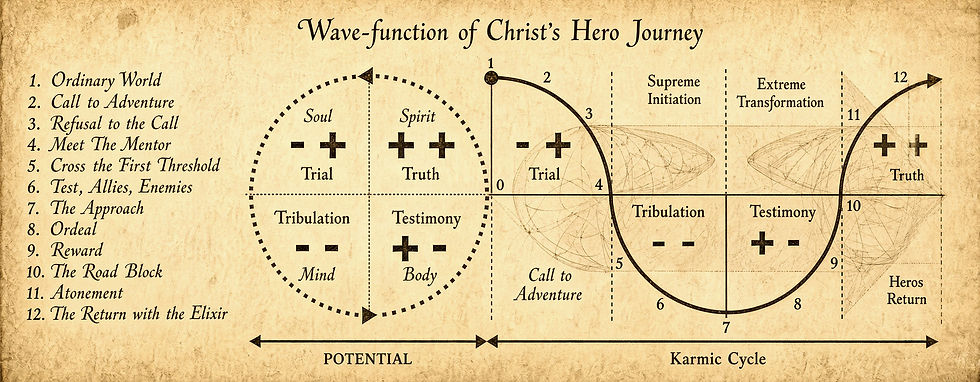
The Journey at a Glance
The twelve stages fall naturally into three movements: the Initiation (stages 1–5), the Supreme Ordeal / Inmost Cave (stages 6–9), and the Glorified Return (stages 10–12).
# | Stage | Moment in Christ's life | Where to read it |
1 | Ordinary World | The Nazareth preparation | Luke 2:39-52; Mark 6:3 |
2 | Call to Adventure | The Jordan baptism | Matthew 3:13-17 |
3 | Refusal of the Call | The wilderness retreat | Matthew 4:1-2; Luke 4:1-2 |
4 | Meet the Mentor | John the Baptist and the prophetic mantle | John 1:29-36 |
5 | Crossing the First Threshold | The miracle at Cana | John 2:1-11 |
6 | Tests, Allies, and Enemies | The desert temptations and ministry friction | Matthew 4:1-11; Mark 3:13-19 |
7 | Approach to the Inmost Cave | The Transfiguration | Matthew 17:1-8 |
8 | The Supreme Ordeal | Gethsemane, betrayal, and the Crucifixion | Matthew 26-27 |
9 | The Reward | The descent into Hades | 1 Peter 3:18-20; Ephesians 4:8-9 |
10 | The Road Back | The Resurrection morning | Luke 24:1-35 |
11 | Atonement | The Resurrection verified | John 20:19-29 |
12 | Return with the Elixir | The Ascension and the gift of the Spirit | Acts 1:9-11; Acts 2 |
Part One: The Initiation
The Ordinary World: The Nazareth Preparation
For His first decades Jesus lived hidden in the small, obscure village of Nazareth, working as a local carpenter. His was a private and unremarkable life of family obligation, concealed in plain sight. Body and mind grew in the ordinary rhythms of human experience; spirit and soul remained quietly aligned. This silent season establishes the baseline of full humanity before the public mission begins.
The Call to Adventure: The Jordan Baptism
The status quo breaks when Jesus steps out of anonymity and travels to the Jordan to be baptized by John. As He rises from the water, the heavens open and the Father’s voice declares Him the Beloved Son. Spirit, soul, mind, and body are publicly affirmed together. This moment marks the official beginning of His earthly ministry and severs Him from the quiet past.
Refusal of the Call: The Wilderness Retreat
Immediately after baptism, Jesus does not rush into public preaching. He withdraws into the isolation of the Judean desert, facing the weight, scope, and vulnerability of the mission ahead. During a forty-day fast, with the limitations of human flesh laid bare, mind and will seek wholehearted alignment. The trails of testing begin here, in solitude rather than spectacle.
Meet the Mentor: The Passing of the Prophetic Mantle
In the wilderness of the Jordan, John the Baptist serves as the mentor who prepares Christ’s earthly transition. He publicly identifies Jesus as the “Lamb of God,” passing the prophetic lineage and authority of the old covenant. This encounter confirms entry onto the public stage and turns the first disciples toward their new teacher.
Crossing the First Threshold: The Miracle at Cana
Jesus formally crosses into public ministry at a wedding feast in Cana of Galilee. Prompted by His mother, He performs His first public miracle, turning water into wine of the highest quality. The event marks the point of no return and signals that a new era has arrived. Body and mind act; spirit and soul release what has been prepared in hiddenness.
Part Two: The Supreme Ordeal / Inmost Cave
Tests, Allies, and Enemies: The Desert Temptations and Ministry Friction
Jesus enters the crucible of public testing. It begins with direct confrontation with the adversary in the desert, where He overcomes three foundational temptations: pride, power, and preservation. Emerging victorious, He gathers twelve disciples as allies while navigating growing friction, traps, and open hostility from religious elites ‘the enemies.’ Mind and spirit remain clear; the trails of testing lengthen.
The Approach to the Inmost Cave: The Transfiguration
Jesus takes His closest companions ‘Peter, James, and John’ up a high mountain, where He is transfigured before them. Face shining like the sun, clothing dazzling white, Moses and Elijah appear beside Him. This glorious event offers a foretaste of future glory. It strengthens resolve and prepares both the One who will suffer and those who will witness. Spirit radiates; soul and mind receive the light before the descent.
The Supreme Ordeal: Gethsemane, Betrayal, and the Crucifixion
Jesus enters the dark heart of the journey. In Gethsemane His soul is sorrowful even unto death; mind and will wrestle until they yield fully to the Father. Betrayal by Judas, arrest, unjust trials, and the Crucifixion at Calvary follow. Body endures physical execution and public humiliation; He gives up His life entirely, suffering real physical death. This is the tribulation at the center of the pattern which was the lowest point of the narrative arc, where spirit, soul, mind, and body are fully spent in love.
The Reward: The Descent into Hades
While the body lies sealed in the tomb, Christ descends into the realm of the dead. He breaks open the gates of spiritual imprisonment and reclaims authority over death and the grave. Entering the deepest captivity, He seizes the ultimate prize: the keys that free human potential and restore eternal life. The reward is won not by escape but by passage through the very place of loss.
Part Three: The Glorified Return
The Road Back: The Resurrection Morning
On the third morning the decisive breakthrough occurs: Jesus rises from the tomb. Passing beyond the Roman guard and the heavy stone, He returns to the land of the living. He begins the road back into human sight, appearing unrecognized to grieving followers on the road to Emmaus, showing that death no longer holds power. Spirit, soul, mind, and body are reunited in a glorified whole.
Atonement: The Resurrection Verified
Jesus appears to His gathered apostles in a locked room and meets the doubt of Thomas directly, inviting him to examine the wounds. The risen, glorified body is tangible, real, and completely victorious. This verification confirms the full and flawless completion of the redemptive mission, reconciling human frailty with divine certainty. Testimony is born in the encounter: what was hidden in tribulation is now shown as truth.
Return with the Elixir: The Ascension and the Outpouring of the Holy Spirit
The journey reaches completion on the Mount of Olives, where Jesus ascends until a cloud takes Him from sight. He returns to the right hand of the Father, having overcome the limits of mortality. From that throne He sends the ultimate elixir ‘the outpouring of the Holy Spirit’ which equips all people for a transformed and victorious life. Trials have been endured, tribulation has been transformed, testimony has been established, and truth is now freely given.
Closing Reflection
Taken together, the twelve stages trace a complete arc: a hidden life, a public calling, a season of trials, a descent through tribulation into death, and a triumphant return that carries testimony and truth for everyone who follows. The same pattern that Joseph Campbell traced across world myth, and that Christopher Vogler adapted as a practical map for storytellers, appears here as history. It has shaped countless films: Luke Skywalker’s call from a desert farm, Neo’s awakening from the Matrix, Frodo’s long road from the Shire, because audiences recognize themselves in the shape of departure, ordeal, and return.
That recognition is the invitation. The monomyth is not only a literary template; it is a mirror. Each person is somewhere on the wave even in this ordinary world, answering a call, facing trials, walking through tribulation, or learning to carry the elixir of a changed life. Christ’s journey does not erase our own; it illumines it. Spirit, soul, mind, and body are invited into the same movement: from hiddenness through testing into the freedom that blesses others. The pattern storytellers have long recognized in myth appears here as history, and it continues wherever a life is willing to be transformed.